
Introduction
The healthcare system in the U.S. is constantly evolving. Patients today require the same digital convenience that they receive from banks or shopping sites. Handwritten ledgers just do not cut it anymore. That is where Healthcare CRM software comes in. These systems are designed to monitor essential tasks such as:
- Track patient visits
- Automated Follow-ups.
- Secure unified messaging.
It is so important to select the appropriate tool because one wrong decision may mean a loss of time and the loss of a patient’s trust. Nevertheless, it requires careful consideration rather than haste to select the most appropriate. Consider it this way: success is not merely software; a healthcare CRM tool is how it will fit the pace of day-to-day patient care.
The role of healthcare CRMs is growing
A healthcare CRM tool is people-oriented and not product-oriented. Through these tools, clinics manage visits, check-ins, payments, and continued support in an easier manner. Since patient satisfaction scores influence funding and public confidence, the use of such tools is no longer a luxury but a standard practice.
Disorganized records slow down daily operations. Things move more slowly if paperwork is scattered everywhere. When data is centralized, staff can locate information within a short time. The speed implies faster responses, less confusion, and errors become a thing of the past. Automated workflows keep the team synced by sending appointment reminders and check-in alerts without manual effort. Time is opened up in cases where machines do repeated work. Results show up in real ways. Those doctors who employ sound CRM systems normally observe:
- Higher loyalty and retention of patients.
- Fewer missed appointments
- Improved interdepartmental communication.
- Improved staff performance
Industry Insight: Research indicates that medical offices with a shared system handle tasks faster. This cuts time spent on office work by more than thirty percent. Workers then spend less energy tracking forms. Attention shifts toward those receiving treatment instead of documents piling up.
Smaller clinics have an advantage over others when they employ a healthcare CRM tool ahead of the curve. Rather than being lost in forms, physicians spend more time where it counts: at the side of the patient. The advantage is felt, though silent and unmistakable, on both sides.
Essential Features That Define a High-Performing CRM
The eye-catching, flashy demos could be of a healthcare CRM tool, but what is more important is the on-the-job activities. Powerful systems have the perfect balance of convenience and privacy regulations, as well as customization.
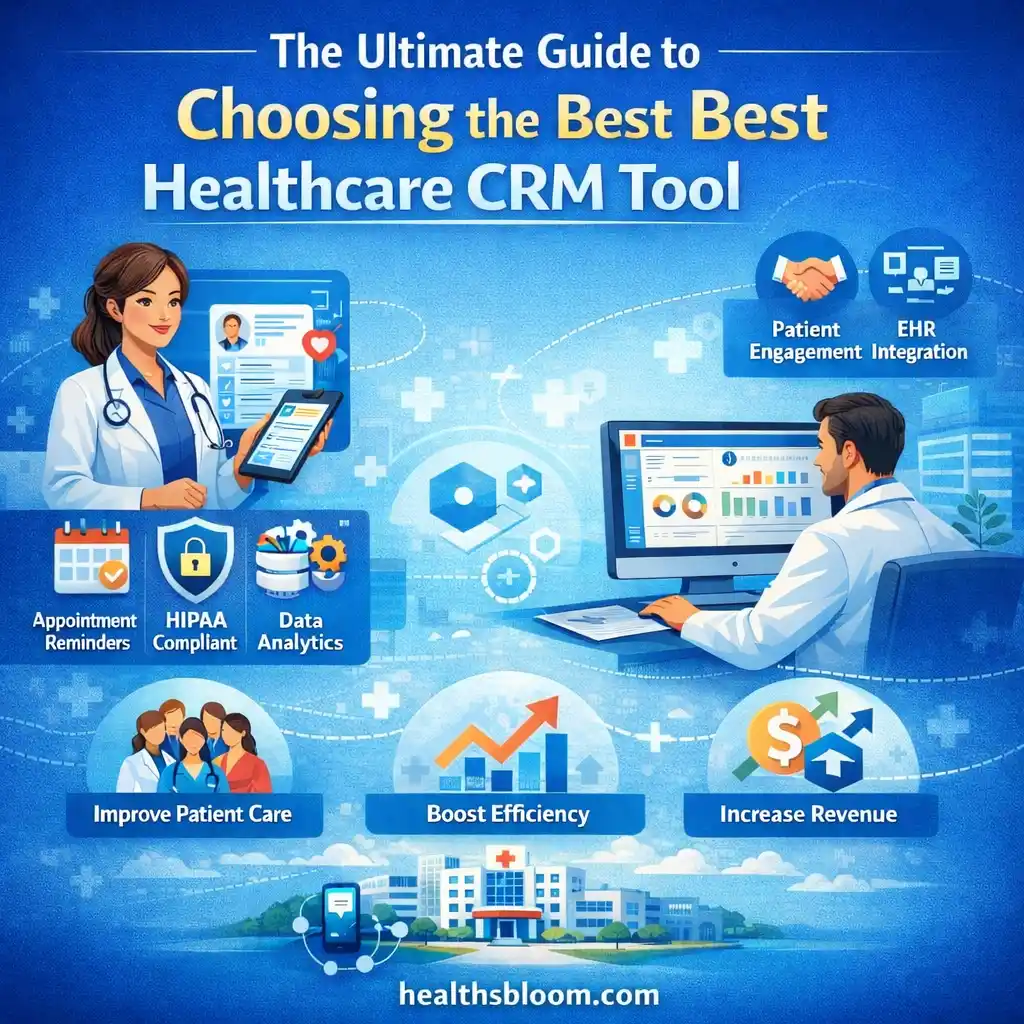
Fulfilling HIPAA requirements isn’t optional from the start. Patient data must be secured – consider encryption, restricted access controls, and secure server environments. Next, system interoperability is essential. The system should be compatible with Electronic Health Records (EHR), invoicing systems, and scheduling systems. When it does not connect with the one you already have, time wasted begins to mount quickly.
Not just HIPAA but also check for Multi-Factor Authentication(MFA), too. Logging in needs a verification code sent to your phone. That way, stolen passwords won’t open medical files. Safety stays strong.
In addition to that, there are convenient extras such as these:
- Automatically sent texts or emails to remind people of appointments.
- Targeted patient segmentation.
- Staff and patients’ secure messaging.
- Patient Portals: A secure area where patients can view their own appointments, test results, and educational materials.
Data Insight: According to our analysis, 60% of the data breaches in smaller clinics happen because of the fragmented spreadsheet. A HIPAA-compliant CRM serves as a security firewall for your patient data.
One should not feel like it is a puzzle to start. The software should be intuitive. If a tool requires constant training, it slows down patient care.
Select a CRM that suits your organisation
What would work in one clinic may not work in another clinic. The selection of a healthcare CRM tool should be based on aligning it with the real needs rather than pursuing all the tools available.
Step 1: Audit your current workflow: Start by checking how things work now. Look closely at what people do each day using paper or files on computers. Write it all down before thinking about new tools. Only then can you spot the holdups, those moments when progress drags. Seeing these delays clearly is necessary if anything should move faster later.
There are simple systems that may suit some smaller clinics where schedules, alerts to patients, and a simple data review may be left to take place. These options are usually cheaper to use, and they are launched within a short period of time via cloud-based deployment. Large hospitals are more inclined to strong platforms with deep reports, monitoring trends of wellness in the community, and connecting numerous teams in different units.
The decision-makers should evaluate their needs before assessing the vendors:
- Who are the ones who are experiencing these problems? What’s breaking down here?
- What are the processes that ought to work better?
- How comfortable are the team members with technology?
Budget is a significant factor, but when it does not have a long-lasting quality, it fails to do the trick. The systems that are expanding with your team may not need costly transitions in the future. What counts? Fit the relationship between tools, staff, and workflows.
The Impact: One out of every four missed appointments disappears when clinics start using a healthcare CRM tool with automatic alerts. After half a year, the drop becomes clearer, fewer empty chairs, better flow. That shift shows up fast in the numbers tracked month by month. Offices notice changes almost right away once messages go out without staff lifting a phone. A quarter fewer gaps appear in the daily schedule simply because patients get timely nudges.
Bringing ideas to practice, learning in the process, and creating sustainable outcomes
A new beginning is nothing without anyone being aware of how to put it to use. Successful implementation begins by getting everyone on board. This is a process that requires plain speaking, as tools cannot cure habits, particularly when change is cumbersome.
Before all that, a person must actually own the process. Having a single person at the helm, specifically someone who understands clinic operations and the role that technology plays in running the clinic, makes the entire situation different. Learning is more effective when each role is tailored to each specific department rather than using generalized sessions. In that manner, reception teams, physicians, and office leaders will clearly understand the point at which the tool intervenes on their behalf.
Long-term success depends on:
- Continued training and refresher.
- Periodic audits and updates of the system.
- Staff and patient feedback loops.
The point of a healthcare CRM tool is that you have to continue using it well. With the expansion of your team, the system to serve the team should be expanded as well. Once the teams perceive CRM application as a process that is perfected over time, the outcomes of improved workflows and improved patient outcomes are likely to follow. The improvement of things depends on the frequency of review.
Future Outlook: Based on search trend analysis, patient demand for “Digital-First” healthcare is rising. Offices that do not adopt CRM technology now may face a higher patient churn rate by 2026.
The Other Side of CRM: Do You Really Need One at the Moment in Your Business?
Although they do well, CRM in healthcare cannot solve all the problems. Clinics with inadequate staffing, archaic electronic records, and financial issues may need to wait a little longer before implementing a CRM. Some physicians are afraid of overdependence on machines because they believe that this would make patient visits feel impersonal. These concerns are valid. The correct strategy involves a healthcare CRM tool to enhance the personal touch and not to lose it. A new system will not solve all problems. Success is driven by the people behind the work—their skills and their morale. Technology matters, but so does who uses it. A tool is only as effective as the workflow it supports.
Read Also: Neuralink: The Future of Brain–Computer Technology Revolutionising Human Capability
Conclusion
Healthcare CRM Tools are a vital long-term investment when used now, and they grow later. Since rules have to be observed, it becomes easier to choose a system that would be appreciated by people. The number of connections between tools is as important as the number of features within the tools. Wise decisions today benefit us all tomorrow, particularly those receiving and offering care. Even minor changes in the team working process would show what type of support is actually required.
A healthcare CRM Tool should eliminate bottlenecks, rather than introduce them. Software silently moves to the forefront of the treatment process as relationships are made central in the treatment process. It is only necessary to watch the daily course of things to see where change assists or wrongs. Even the tiniest enhancements are felt when the pressure never goes off. There are platforms on which the administrative burden is lifted seamlessly.
Frequently Asked Questions
What is the difference between a Healthcare CRM tool and an Electronic Health Record (EHR)?
To the extent that an EHR is applied with the purpose of clinical documentation and storage of the medical history, a Healthcare CRM is concentrated on the relationship and communication with the patient. The medical notes of the doctor belong to the EHR; the appointments, marketing, patient feedback, and automated communication belong to the CRM. A CRM should be connected to your EHR so that you can achieve the best results.
Does a small clinic really need a healthcare CRM tool?
Yes. In fact, it is usually smaller clinics that achieve the most short-term gains since they have fewer personnel to manage the administrative side. CRM can automate such manual tasks as appointment and follow-up email reminders so that a small staff can offer the level of service a big hospital would offer without recruiting additional help at the front desk.
Is patient care made to feel impersonal by the usage of a healthcare CRM tool?
Actually, it is the opposite. This is because by automating the tedious paperwork aspect of the relationship (such as verifying address details or sending text messages), doctors and nurses have more time to actually spend with the patient during the visit. CRM also keeps personal preferences, and staff members will not forget minor details that will make a patient feel individual, valued, and heard.
In the case of a new CRM, what is the average duration of implementation?
In the case of a cloud-based system, the technical implementation can occur at a speedy pace. Yet, an effective implementation, such as training the staff and integrating the workflow, typically requires 4 to 8 weeks. This is because it is important to have a champion in the office who can spearhead the transition.
What is the greatest risk in the selection of CRM?
The greatest threat is the absence of interoperability. When the healthcare CRM tool is not compatible with the existing scheduling or billing software, your employees will be forced to do a kind of double entry (type the same information in two systems) to make things work. This causes increased work and causes of errors. You should always make sure that the tool is compatible with your existing tech stack before concluding a contract.
Disclaimer: Information on Healthsbloom.com is for educational purposes only. We do not provide legal or medical advice. Consult a professional before selecting any software tools.
Source: Gartner Magic Quadrant for the CRM Customer Engagement Center (CEC).
